Korea Travel Guide — Seoul & Busan
My experiences and recommendations for travelling to Korea
Before You Go
Entry & Customs
Use the Korea Customs app to enter all your arrival data before you land. Korea now has a digital arrival card, which makes the process at immigration noticeably smoother and faster. The card can only be filled up to two days in advance and allows easy filling for families.
Even when you do not need to apply for a VISA to enter South Korea, you will need to have a valid Korea Electronic Travel Authorization (K-ETA) document. It is valid for 2 years and costs around $8.
The document can be filled longer before and will be checked when checking in for the flight. Approval works usually in less than 30 minutes.
Money
- Get a T-money card at Incheon Airport or at any 7-Eleven in the city. This is your essential transport card for buses and subways — every person needs their own card.
- Always carry some cash. Some restaurants only accept cash or Korean credit cards — meaning neither Apple Pay nor European cards will work.
- A Wise card works well in Korea and can exchange to Korean Won (KRW). It's a reliable backup for daily spending.
- Use the Naver app to locate nearby ATMs when needed.
Mobile Data
Korea's mobile networks are fast — genuinely among the best in the world. Getting connected before you land is straightforward. Unfortunately, my Swiss mobile contract had only a very limited data volume for South Korea and any other Asian country and the price per MB is very high.
eSIM
The easiest option is to set up an eSIM in advance using the Airalo app. You can purchase a short-term Korean data plan with unlimited 5G for a fixed price, and activate it before you board. Use the referral code **DANNY1325** to get USD $3.00 off your first eSIM, or use this link: airalo.go.link/4oXV3
Free Wi-Fi
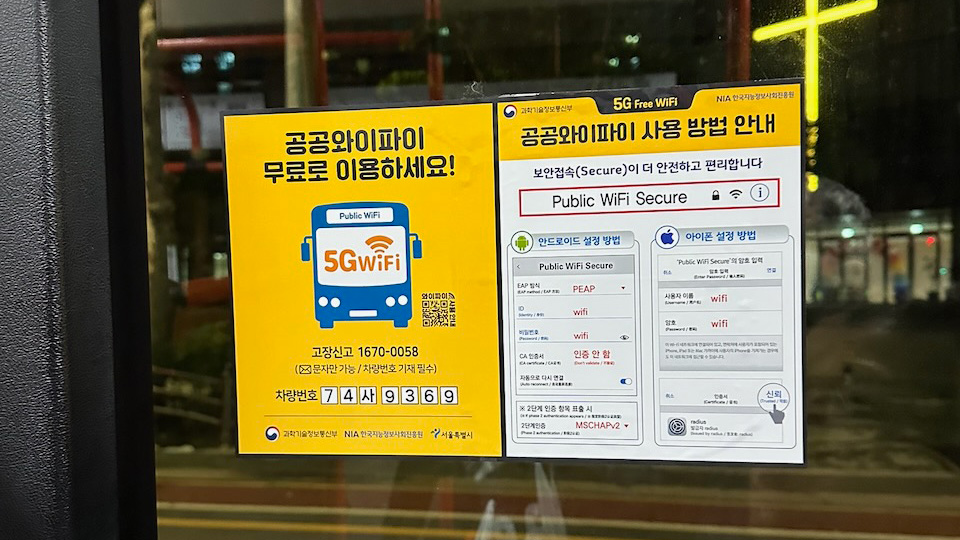
*Setup instructions for the public Wifi in a bus in Seoul*
- Buses — most public buses have free Wi-Fi on board. Setup instructions are posted near the doors.
- Cafes — virtually all cafes offer free Wi-Fi. Just ask staff for the password if it isn't posted.
Getting Around
From Incheon Airport to the City
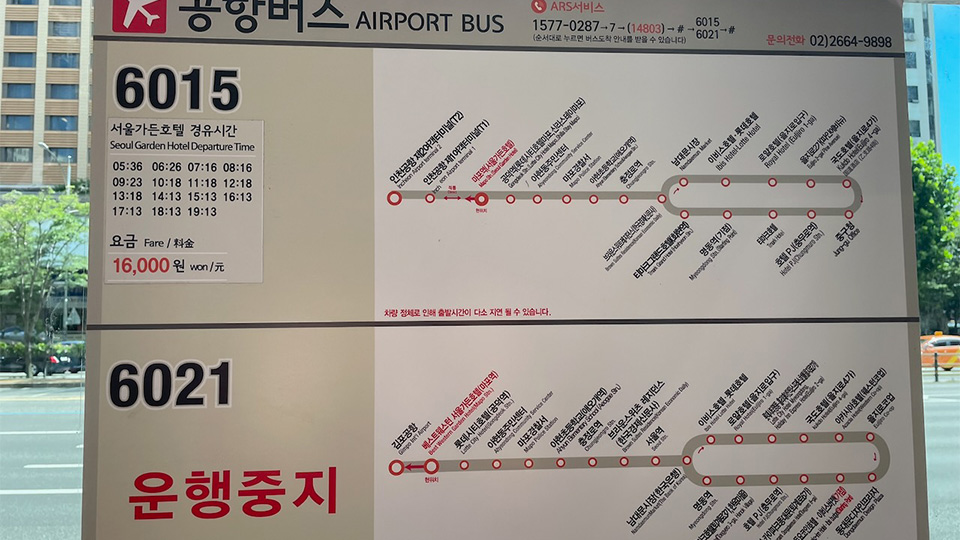
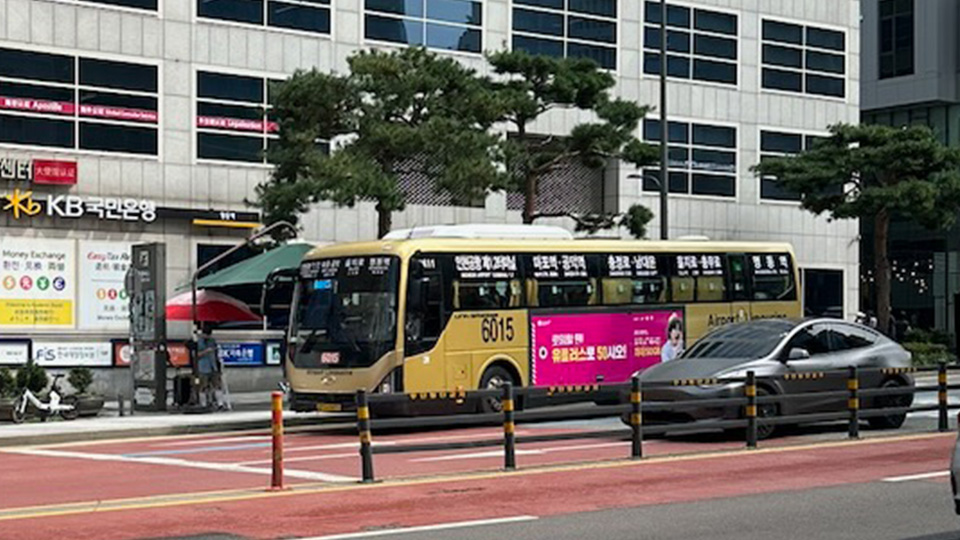
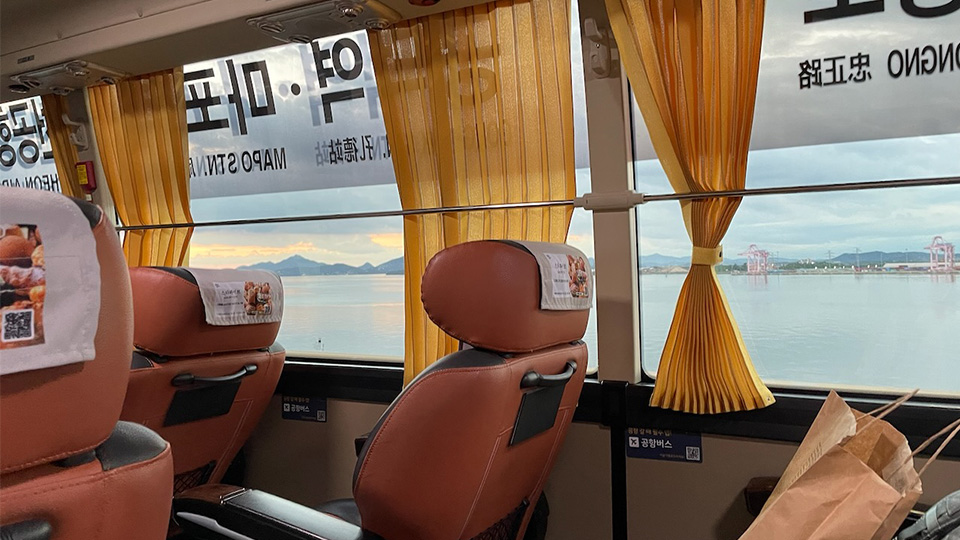
The easiest option is one of the airport buses. Tickets are bought outside Terminal 1 — check the routes in advance to find one that goes close to your accommodation. Budget a little over an hour for the journey.
If you are staying near Seoul Station, you can also take the fast AREX train. Payment is possible with a T-money card and possibly Apple Pay.
Public Transport
Korea's public transport is excellent. A few things to know:
T-money card
Tap in and tap out every time — on buses and subways. The system automatically calculates the best fare across transfers. There are currently no cash payments on buses and Apple Pay tap-to-pay is not yet widely rolled out for public transport, so do not rely on it.
Buses in Seoul
Board at the front of the bus only — this is where you pay, next to the driver. Always tap out when leaving.
Naver Map
Install the Naver app before you arrive. It is far more detailed than Google Maps for Korea — it shows real-time bus and subway capacity, departure times, the best exit to take at each station, and even which wagon door to stand at on the platform (marked on the floor) for the shortest transfer route. Plan any trip with it.
Elevators exist at most stations but are generally reserved for elderly passengers and those with mobility needs.
Taxis
Use Uber to order taxis in Seoul — it works with a Swiss or European credit card, unlike local taxi apps which do not accept foreign cards. You can also order for cash payment if preferred.
Seoul to Busan
Travel by KTX high-speed train. Buy tickets well in advance as popular departures sell out quickly. Use the Korail Talk app to book — it accepts credit cards, though the app takes a little patience to navigate.
Practical Tips
- Trash — there are almost no public bins in Seoul. Carry a small bag for your rubbish.
- Attractions closed on Mondays — many public sites including palaces are closed on Mondays. Check opening days before you plan.
- Cherry blossom season — if visiting in spring, check the forecast for blossom timing before you go. When it coincides, the parks are spectacular.
- Translation — the Papago app translates Korean well, including signs and menus via the camera.
- Free refills — in most Korean restaurants, kimchi and water are free refill. A welcome habit.
Seoul
Getting Your Bearings
Seoul is a large city but very well connected by metro and bus. The Naver Map app makes navigating it straightforward. A good base area is anywhere near the city centre with metro access.
Things to Do
Gyeongbokgung Palace
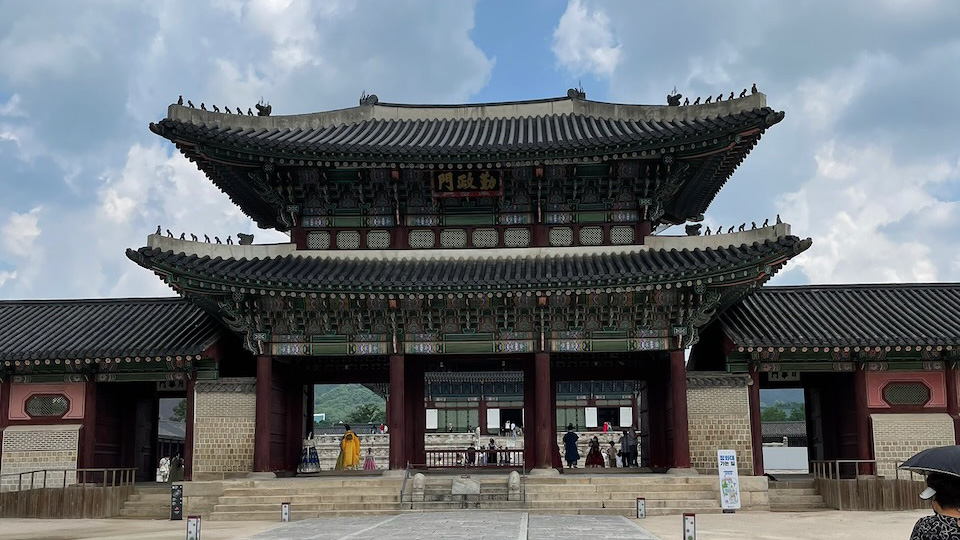
The city's most iconic palace and a must-visit. Wear a Hanbok — the traditional Korean dress — and entry to the palace is free. Rental shops are everywhere around the entrance. Hire a photographer for an hour while you're at it; they know the best spots inside the palace grounds and will make the most of the setting.
Gwanghwamun Square
Directly in front of Gyeongbokgung, the square features statues of King Sejong and Admiral Yi Sun-sin — two excellent photo spots.
National Museum of Korean Contemporary History
Situated on the side of Gwanghwamun Square, this is an interesting and well-paced museum — not overwhelming in size, but genuinely informative about modern Korean history.
Jogyesa Temple
Just a few minutes' walk away, this is a quietly beautiful Buddhist temple in the middle of the city. A calm contrast to the busier sights nearby.
National Museum of Modern and Contemporary Art, Seoul
A short distance further north, this museum hosts strong rotating exhibitions and is worth an afternoon.
The Alleys Around Yulgok-ro 3-gil
Behind Gyeongbokgung and the art museum, explore the small alleys lined with traditional hanok houses, independent cafes, and quiet corners. One standout is Nuldam Space – Gyeongbok Palace Branch, where you can write a postcard to yourself to be delivered in the future.
Namsan Seoul Tower
A classic Seoul landmark on a hill above the city. You can take the small cable car up, hike the shorter route, or hike the full trail up. There is also a bus going up and down. The view over the city is worth it.
Gwangjang Market
For traditional Korean food, this is the place. One of Seoul's oldest and most authentic markets — ideal for trying a range of local dishes in an atmospheric setting.
Yeouido Hangang Park
A great spot for a picnic, especially on weekends. Bring cash and an ID card — you can rent a mat and a small low table on-site. Small food stalls and convenience stores are nearby. In spring, this is also one of the best spots to see cherry blossoms along the river.
Gyeongui Line Forest Park
A former railway line converted into a long green park, south of Gongdeok Station. It is a pleasant walk through a busy part of the city. Follow it north and it leads up into the vibrant Hongdae neighbourhood — full of cafes, shops, restaurants, and a lively student atmosphere.
Ewha Womans University
Not far from Hongdae, the university campus is a nice photo stop with distinctive architecture.
COEX Mall
A large underground mall worth visiting for two reasons: the Starfield Library, a dramatic open bookshelf atrium that is one of Seoul's most photographed interiors, and the COEX Aquarium.
Bongeunsa Temple
On the other side of the street of COEX Mall is Bongeunsa Temple, a working Buddhist temple in the middle of the Gangnam district — a striking contrast to its surroundings.
DMZ Day Trip
A day trip to the Demilitarized Zone on the border with North Korea is a genuinely interesting experience. Book early through an agency — Klook has many options — as visitor numbers are sometimes limited and it takes time to get there. The scale and atmosphere of the place is hard to describe. Go with clear weather expectations; visibility can vary.
Busan
Getting Your Bearings
Busan is Korea's second city, on the southern coast. It has a very different feel to Seoul — more relaxed, coastal, with great seafood. There is only one metro line, so some sights require a bus.
It can be easily reached with the KTX train from Seoul.
A good area to stay is Suyeong-gu, which has views of the Gwangan Bridge and excellent seafood restaurants nearby.
Things to Do
Gamcheon Culture Village
A hillside neighbourhood of colourful houses, murals, small galleries, and cafes. Visually striking and great for photos. Take the metro and then a bus to get there.
Busan Tower (Yongdusan Park)
A separate stop from Gamcheon, in the city centre. Climb up for a view over the port and city. Worth combining into a day out in the central area.
Haeundae Blueline Park
Take the coastal cable car one way and walk back along the coast — the sea views are excellent. Allow enough time and go when the weather is good; the walk takes a while but the route is enjoyable.
Haedong Yonggungsa Temple
A Buddhist temple built on the rocky coastline — one of the few seaside temples in Korea and genuinely beautiful. Reachable by bus; a bit further out but worth the journey.
Dongbaek Park
A peaceful park on a small peninsula. Nice for a walk, with good views of the coastline and Gwangan Bridge.
Seafood
Busan is the place for fresh seafood in Korea. The area around Suyeong-gu has many good options — explore and ask locals for recommendations.
Discussion